11 Cool Borders to Draw in Your Journal
There are many cool borders to draw that help transform a plain journal page into a clean and creative layout.

Blank journal pages often look plain. A simple border changes the page fast. Borders guide the reader’s eye, organize notes, and add personality to your layout.
If you are looking for easy borders to draw, this guide shows practical ideas you can draw in minutes.
Many journal users add small frames around pages to improve structure. A border separates sections, highlights titles, and makes pages look clean and intentional. As a writer who studies drawing trends and journal layouts, I notice a clear pattern.
Simple repeating shapes such as dots, leaves, stars, and lines work best because they are easy to draw and look good across many page styles.
In this article, you will learn 11 cool borders to draw in your journal. Each idea uses basic shapes and quick strokes, so beginners can draw them without complex techniques. So let’s get right into it.
11 Cool Borders to Draw in Your Journal
Below you will find simple and cool borders to draw in your journal. Each design uses basic shapes that you repeat along the page edge.
You can start with light pencil lines, then trace with a pen once the pattern looks balanced.
1. Dotted Border
A dotted border ranks among the easiest borders to draw in a journal. You can start by placing small dots along the edge of the page with equal spacing.
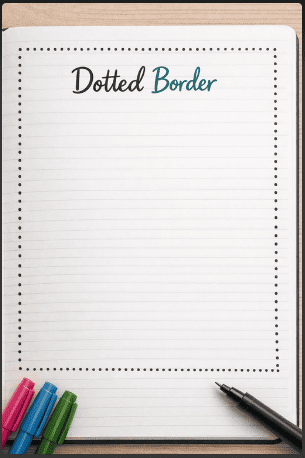
Move slowly around the page so the dots stay aligned. This style works well because the pattern stays simple and clean while still giving your page structure.
If you want a thicker border, draw two rows of dots close together. Many journal users choose this style for study notes and planners because the border adds visual structure without distracting from the text.
You can use a black fine liner for a minimalist look or colored pens to match your page theme.
Related blog post: 25 Corner Page Doodle Ideas for Your Notebook.
2. Wavy Line Border
A wavy line border creates a relaxed and creative frame around the page. You can begin with a soft wave line along the page edge. Keep the movement smooth so the waves stay consistent.
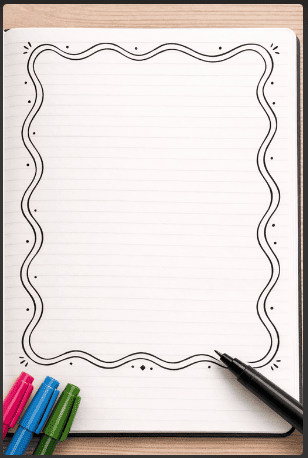
After finishing the first line, add a second wavy line next to it to give the border more depth. This design works well for personal journals, sketchbooks, or creative writing pages because the curves feel less rigid than straight lines.
If you want more decoration, add small dots or stars between the waves. This small detail makes the border look fuller without making the drawing process complicated.
3. Leaf Vine Border
Leaf vine borders bring a natural look to journal pages. So start with a curved line that runs along the edge of the page. This line acts as the vine.
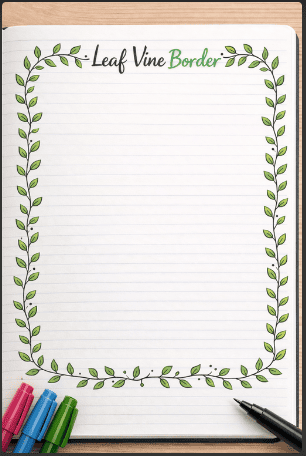
After drawing the vine, add small leaves on both sides of the line. Keep the leaves simple with almond-shaped outlines and a center line.
The repeating leaf pattern builds a clean decorative frame that works well for gratitude journals, nature notes, or aesthetic planners.
Many artists keep the leaves evenly spaced to create balance across the page. You can also color the leaves lightly with green markers to add subtle detail without overwhelming the page.
4. Star Doodle Border
A star doodle border adds a playful and creative look to journal pages. You can start by drawing small stars along the page edge.
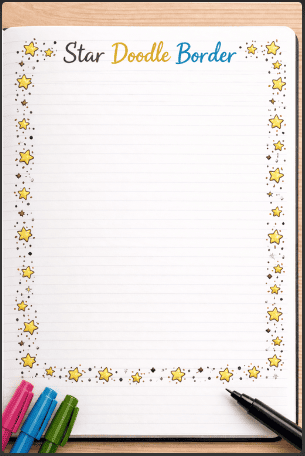
Use simple four-point or five-point star shapes so the drawing stays quick and consistent. Make sure you leave small gaps between stars so the border does not look crowded.
After placing the stars, fill empty spaces with tiny dots or sparkle lines. This combination creates a decorative frame that feels energetic and light.
Many people use star borders for mood journals, dream journals, or creative writing pages because the design gives the page a positive and expressive style.
5. Chain Link Border
A chain link border creates a repeating pattern that looks structured and neat. Start by drawing small oval shapes along the edge of the page.
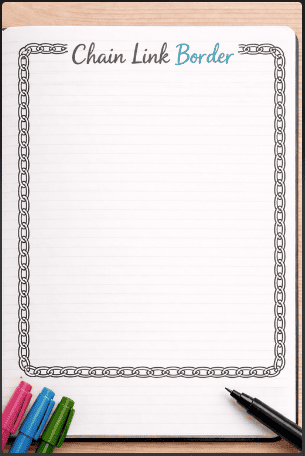
Each oval should slightly overlap the next one so the shapes appear connected. Continue repeating the pattern until the entire page forms a linked frame.
This border works well for bullet journals and planners because the design looks organized and balanced. You can also shade one side of each oval to give the chain a subtle three-dimensional effect.
The pattern stays simple, yet the repetition makes the border visually interesting.
6. Floral Corner Border
Floral corner borders decorate the page without taking up too much space. Instead of drawing along every edge, focus on the four corners of the page.
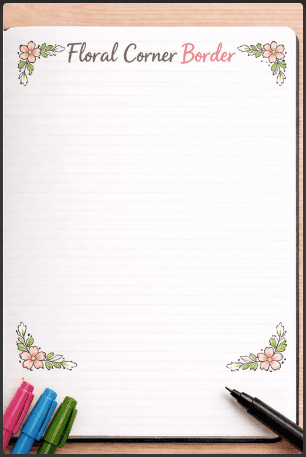
You will begin by sketching a small flower in one corner, then add two or three leaves around it. Repeat the same idea in the remaining corners.
This layout leaves the sides of the page open, which gives you more room for writing. Floral corner designs work well for aesthetic journals, gratitude pages, and personal reflections.
Because the decoration stays limited to the corners, the page still looks clean while the flowers add a soft artistic touch.
7. Zigzag Border
A zigzag border creates a bold geometric frame around the page. Draw diagonal lines that connect in sharp angles as you move along the page edge.
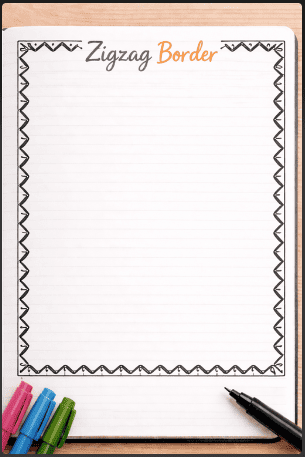
Keep the angles consistent so the pattern stays balanced. This design stands out more than softer borders because the sharp edges attract attention.
Many journal users apply zigzag borders around titles, section headers, or important notes. If you want to make the border stronger, trace the zigzag lines with a thicker marker or fill alternating sections with color.
This technique adds contrast and helps the border frame the content clearly.
Related blog post: 11 Easy Painting Ideas on Canvas for Beginners.
8. Bubble Border
Bubble borders bring a playful and friendly look to journal pages. Start by drawing small circles along the page edge.
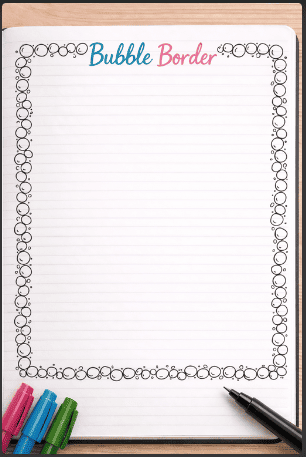
Allow the circles to slightly overlap so they resemble bubbles touching each other. Continue repeating the circles until the page forms a rounded frame.
To enhance the effect, add a small highlight circle inside each bubble. This small detail creates the illusion of shine and makes the border look more lively.
Bubble borders work well for creative journals, doodle pages, and light-hearted notes. Because the shapes remain simple, beginners draw this border quickly without difficulty.
9. Heart Border
Heart borders add warmth and personality to journal pages. You can start by drawing small hearts evenly along the edge of the page. Keep the hearts similar in size so the border looks balanced.
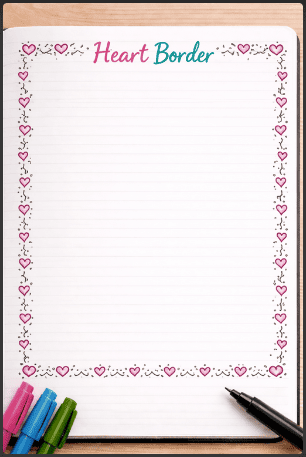
Once the main hearts appear around the page, fill the gaps with small dots or tiny lines. This technique helps the design feel complete while keeping the drawing process simple.
Heart borders work well for personal journals, gratitude pages, or memory logs. The repeated shape creates a decorative frame while still keeping the focus on the writing inside the page.
10. Geometric Pattern Border
A geometric border uses repeating shapes to create a structured and modern frame. Start with a simple shape such as a triangle or square.
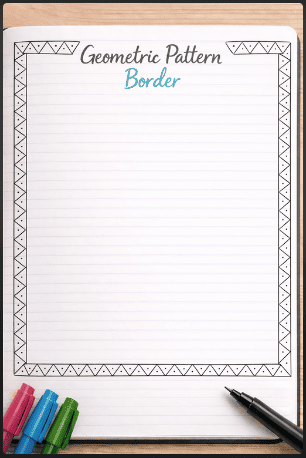
You‘ll draw the shape along the edge of the page, then repeat it in a continuous pattern. Many journal users prefer triangles because they form a clean zigzag pattern across the border.
Use a ruler if you want sharper lines and more symmetry. Geometric borders work well for minimal journal layouts because they add decoration without appearing messy. You also gain flexibility by switching shapes or adding small dots inside each shape.
11. Ribbon Banner Border
A ribbon banner border works well when you want a border that also highlights titles. Draw ribbon shapes across the top or bottom of the page with small folded ends.
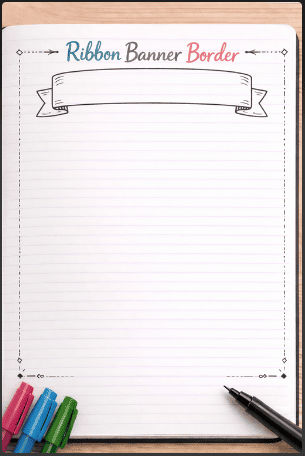
These ribbons create a banner effect that frames the content area. Many journal users write page titles or section headings inside the ribbon space.
After drawing the banner, extend thin lines or small decorations along the sides of the page to complete the border.
This design works well for planners, monthly spreads, and study notes because the banner draws attention to the most important text.
Best Pens and Supplies for Drawing Borders
The tools you choose influence how clean and consistent your journal borders look. Simple supplies give you better control and help you draw precise shapes along the page edge.
Here are some essential tools for drawing journal borders:
Fine liner pens: Fine liners produce sharp and consistent lines. Many journal users prefer sizes between 0.3 and 0.5 because these tips create clear borders without taking up too much space on the page.
Black gel pens: Gel pens create darker lines than many fine liners. This makes borders stand out clearly on the page, which works well for titles, headers, and bold decorative frames.
Colored markers: Markers add visual variety to journal pages. Use them to highlight shapes such as leaves, hearts, or stars. Limiting the color palette keeps the border clean and balanced.
Mechanical pencil: A mechanical pencil helps you sketch the border layout before inking. Light pencil outlines guide your drawing and reduce mistakes when repeating shapes.
Ruler: A ruler improves accuracy for geometric borders. Use it for straight frames, triangle patterns, or square designs along the page edge.
Eraser: A clean eraser removes sketch lines after tracing the border with ink. This step leaves the final border crisp and professional-looking.
Using these basic tools helps you create neat borders and maintain consistent shapes across your journal pages.
Tips for Drawing Journal Borders
Clean journal borders come from simple habits. Good spacing, repeated shapes, and light sketching improve the final look of your page.
Use these tips while drawing borders to keep your layouts neat and balanced:
Sketch with pencil first: Draw a light outline before using ink. Fix spacing or alignment before tracing.
Repeat simple shapes: Use dots, leaves, stars, or triangles. Repeating shapes creates clean patterns.
Keep spacing even: Place shapes at equal distances so the border looks balanced.
Leave writing space: Keep a small margin between the border and your text.
Use thin lines: Thin borders frame the page without distracting from notes.
Limit colors: Use one or two colors to keep the layout clean.
Practice one style: Repeat the same border style across pages to improve control.
Conclusion
Drawing borders adds structure and personality to your pages. These borders to draw use simple shapes and repeating patterns, which makes them easy for beginners and quick to add to any journal layout.
You can start with one or two designs and practice them across different pages. With time, your lines will become cleaner, and your borders will look more balanced.
Use these ideas in planners, study notes, bullet journals, or daily writing pages to make your journal look organized and creative.
Thank you for reading this article. I hope you have found it useful and helpful.
More blog posts:





FAQs About Border Drawing on Paper
Here are some frequently asked questions about drawing borders in your journal:
What are the easiest borders to draw for beginners?
The easiest borders to draw use simple repeating shapes. Good beginner examples include dotted borders, wavy lines, hearts, stars, and small circles.
These shapes require little precision, and you repeat them along the page edge. Because the pattern stays simple, beginners maintain even spacing and produce a clean border quickly.
How do you make journal borders look neat?
Start with a light pencil sketch to guide the border placement. Keep shapes evenly spaced and repeat one pattern across the page. Use thin pens such as fine liners for cleaner lines.
Leave a small margin between the border and the writing area so the page stays readable and organized.
What tools work best for drawing journal borders?
Most journal borders require only a few basic tools. A fine liner pen helps create sharp lines, while a black gel pen produces bold borders.
Many people also use a mechanical pencil to sketch the design before tracing it with ink. A ruler helps when drawing geometric borders or straight frames.
How do you draw borders quickly in a journal?
Choose borders that rely on repeating shapes such as dots, triangles, or leaves. Start in one corner and move slowly along the page edge while repeating the shape.
This method keeps spacing consistent and reduces mistakes. With practice, you will draw simple borders around a page in less than a minute.
What are some creative borders to draw in a journal?
Creative borders include leaf vines, bubble borders, zigzag patterns, star doodle borders, and floral corner designs. These styles add decoration while keeping the drawing process simple.
Many journal users combine shapes such as stars and dots to create unique border patterns.
Why do people add borders to journal pages?
Borders improve page structure and make notes easier to read. A simple frame separates sections, highlights titles, and gives the page a finished appearance.
Many people also use journal borders to add creativity and personality to planners, study notes, and personal journals.