How to Doodle for Beginners? Step-by-Step Tutorial
If you want to learn how to doodle for beginners step by step, this guide will show you exactly where to start and what to do next.
Many people think they need drawing skills to doodle. That is not true. Doodling is one of the easiest ways to start drawing because you only use simple shapes and lines. You don’t need experience or expensive tools to get started.
In this article, you will follow a step-by-step process. You will learn how to draw basic shapes, turn them into simple doodles, and practice in a way that helps you improve fast.
By the end of the article, you will have a simple system you can use every day to create your own doodles with confidence. So let’s get started now.
Note: Some links in this article are affiliate links.
What Is Doodling?
Doodling means drawing simple shapes, lines, or small objects without pressure. You do not aim for perfection. You focus on movement and ideas.
You should think of doodling as a relaxed form of drawing. You can draw anything that comes to mind, even random shapes. Over time, those shapes turn into recognizable objects.
Here is how doodling is different from drawing:
Drawing often focuses on accuracy and detail.
Doodling focuses on simplicity and repetition.
Drawing takes more time and planning.
Doodling is quick and spontaneous.
I recommend starting with doodling because it removes pressure. You build confidence while learning basic drawing skills.
Related blog post: 15 Sketchbook Drawing Ideas for Beginners.
Tools You Need to Start Doodling
You do not need expensive tools to start. You should keep your setup simple so you can focus on practice instead of equipment. A basic pen or pencil and any paper are enough to begin.
If you want to improve your results, you can use a black fineliner for cleaner lines or markers to add color. A sketchbook can also help you stay organized and track your progress.
If you prefer digital drawing, you can use a tablet or phone, but I recommend starting with paper because it helps you focus better and build control.
How to Doodle for Beginners: Step-by-Step
You should follow these steps below in order because each one builds on the previous one. This method helps you improve without feeling overwhelmed.
Step 1: Start With Basic Shapes
You should begin with simple shapes because every doodle comes from them. Focus on circles, squares, triangles, and ovals. Draw them repeatedly until your hand feels more comfortable.
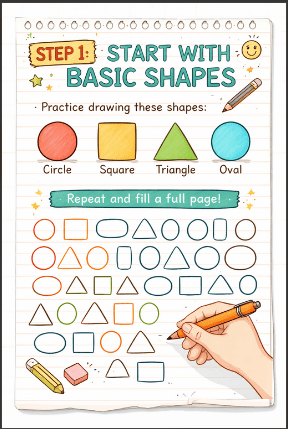
Do not worry if your shapes are not perfect. The goal is to build control and consistency. I recommend filling a full page with shapes to get used to the movement.
Step 2: Practice Lines and Patterns
Next, you should train your hand by practicing different types of lines. Start with straight lines, then move to curved, zigzag, and wavy lines. This helps you control your pen and improves the quality of your doodles.
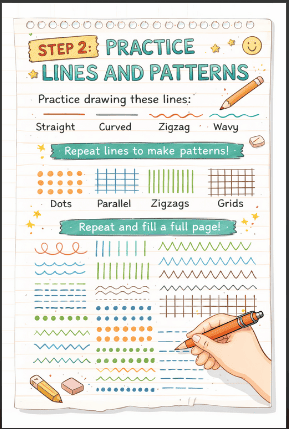
You can also create simple patterns, such as repeating dots or parallel lines. These exercises may look basic, but they lay the foundation for cleaner, more confident drawings.
Related blog post: 15 Easy Doodle Drawing Ideas for Beginners.
Step 3: Turn Shapes Into Simple Objects
Now you should turn your shapes into small drawings. For example, you can turn a circle into a sun, a face, or a flower. A square can become a house or a box, while a triangle can become a tree.
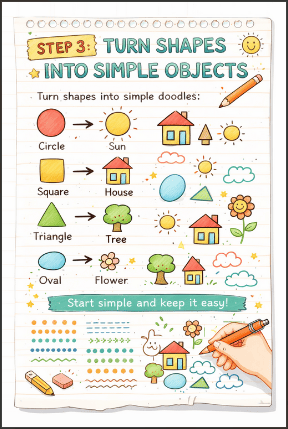
You should keep your drawings simple at this stage. Focus on recognizing how shapes form real objects. This step helps you understand how doodling works.
Step 4: Combine Shapes to Create Doodles
Once you feel comfortable, you should start combining shapes. This allows you to create more interesting doodles without making them complex.
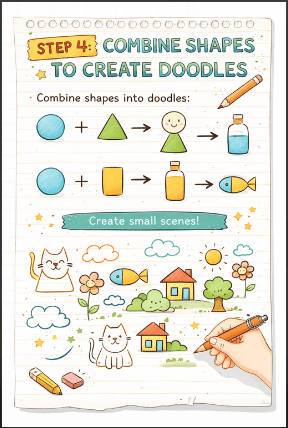
For example, you can combine a circle and a rectangle to draw a simple character. You can also create small scenes by putting multiple doodles together. I recommend experimenting and trying different combinations to build creativity.



Step 5: Add Details and Texture
At this point, you should add small details to improve your doodles. You can include dots, short lines, or simple shading. These details make your drawings look more complete without adding complexity.
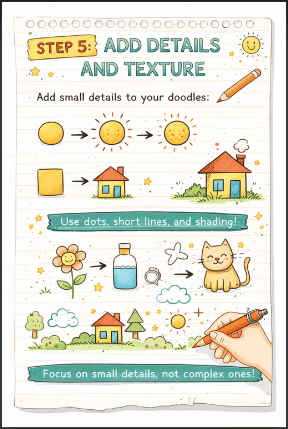
You should keep details minimal. Too many details can make your doodles look messy. Focus on small touches that improve the overall look.
Step 6: Create a Full Doodle Page
Finally, you should fill a full page with doodles. This is where everything comes together. You can draw random objects, repeat shapes, or mix patterns and small drawings.
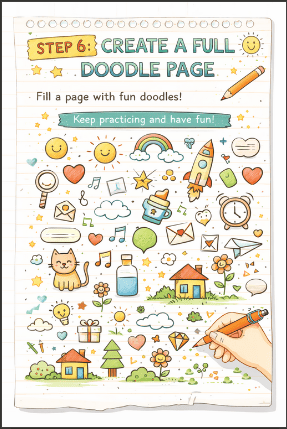
This step helps you practice freely without thinking too much. I recommend doing this often because it builds confidence and improves your speed.
Easy Doodle Ideas for Beginners
If you don’t know what to draw, you should start with simple ideas. These are easy to repeat and help you build confidence.
You can try:
Cute faces with different expressions.
Flowers and leaves using simple shapes.
Stars, clouds, and hearts.
Food items like coffee cups or fruits.
Small animals like cats or fish.
Everyday objects like books or phones.
You should pick a few ideas and repeat them many times. This helps you improve faster.
Simple Doodle Exercises to Improve Faster
You should include short exercises in your routine because they help you improve quickly. Even a few minutes each day makes a difference.
Try these:
Set a 5-minute timer and fill a page with doodles.
Draw as many objects as possible using one shape.
Copy simple doodles from references.
Draw without lifting your pen.
Fill shapes with patterns.
I recommend doing at least one of these exercises daily to build consistency.
Common Mistakes Beginners Make
You should avoid common mistakes because they slow your progress. Many beginners focus too much on perfection, which makes them feel stuck.
Some mistakes to avoid:
Trying to make every doodle perfect.
Adding too much detail too early.
Comparing your work to others.
Skipping daily practice.
Using too many tools at once.
If you focus on simple practice and consistency, you will improve faster.
FAQs About Doodling for Beginners
Here are some frequently asked questions:
How long does it take to learn doodling?
You can start doodling on your first day, but improvement comes with regular practice. If you spend 5 to 10 minutes daily, you will notice better control and cleaner shapes within a few weeks. I recommend staying consistent instead of practicing for long hours once in a while.
Do you need talent to doodle?
You do not need talent to doodle. You improve by repeating simple shapes and lines. With practice, your hand control and ideas get better over time, so you should focus on consistency.
Can you learn to doodle at home?
Yes, you can learn doodling at home with basic tools like a pen and paper. You should follow simple guides and practice daily. You can also use online ideas for inspiration and improvement.
What is the easiest thing to doodle?
The easiest things to doodle are simple shapes and basic objects. You should start with circles, lines, and squares, then turn them into small drawings like faces, flowers, or stars.
Conclusion
You should start with simple shapes and practice every day. You do not need to wait until you feel ready. The more you practice, the more confident you become.
I recommend starting now. Pick one exercise, fill one page with doodles, and repeat this daily. Over time, you will see clear improvement in your lines, ideas, and creativity.